Tablet Form Factor
by Matt CholickI've collected several Android devices over the past couple years and decided I'd share some of my thoughts. Normally, I would leave this to Ars Technica and other, similar sites. The reason I decided to put something up here is to contrast all the praise for the 7" form factor is useful; it's not good for me.
I think it's critical to preface a review with the reviewer's perspective. Here's mine
- I'm a software developer. I can't do much of my work from a tablet. I can read a little email, but that's it. This means that I always have a laptop and any tablet is relegated to a pure consumption devices. A tablet is only useful to me if it's going to outperform my laptop in some way at consuming content.
- I have a Kindle and love reading on the device. The Kindle is feather-light and uses an E-Ink screen; tablets just can't compete with that reading experience.
- I rarely travel. Any device I purchase is mostly going to be used around the house.
Given my perspective, I really only have a few use cases for a tablet: watching movies, reading things that don't work on a Kindle, and reading my RSS feeds.
When I last moved, I got rid of my TV. It was an old CRT model and not worth hauling across the country. It saw little use anyway, so I didn't feel bad letting it go. I do watch hours of Netflix a week (and sometimes Prime streaming or Hulu), so I still need some way to view that content. A desktop machine doesn't work out that well for this - mostly due to room arrangement and seating. I'll sit in bed with the machine on my chest watching things now. My development laptop is too big for that though. I have a Transformer tablet which turned out to be the perfect size. The stiff hinge also lets me adjust the angle of viewing. The Nexus 7, though, is just too small. I hoped it might replace my Transformer, but its small screen size isn't usable for TV.
My second use case for a tablet is non-Kindle reading. The content I can't read on a Kindle falls into two major categories. The first is reading full page pdfs. These are white papers, journal articles, or computer books. I've tried converting these for a Kindle, but it doesn't work out well. Most content of this type has special formatting for code sections or diagrams that don't translate well. These pdfs are something that I do read often, so a good experience is important. The Nexus 7 doesn't for this either, again due to its size. The screen is too small to display a full page, and reading this type of content in a flow layout doesn't work well. The page-per-screen layout is the only viable way I've found to consume this content on a tablet, and that takes a 10" screen. My transformer is a little too heavy for this use, but it works best from the things I've tried.
The second type of non-Kindle reading that I do is through Pocket. Instapaper is an equivalent tool in this space. Both apps strip out navigation and other content from an article and save it in a clean format for later reading. The Nexus 7 actually does shine here; it's great for reading Instapaper-style articles.
The final use case I have for a tablet is consuming my feeds. A laptop is actually pretty good at this, but something lighter and a little more suited to reading can be an improvement. The Nexus 7 fails at this taks, too, due to its smaller size. Two screen shots of the Google Reader app follow:
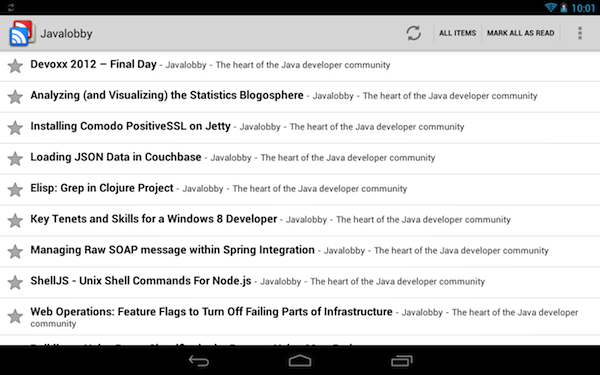
Reader on Nexus 7
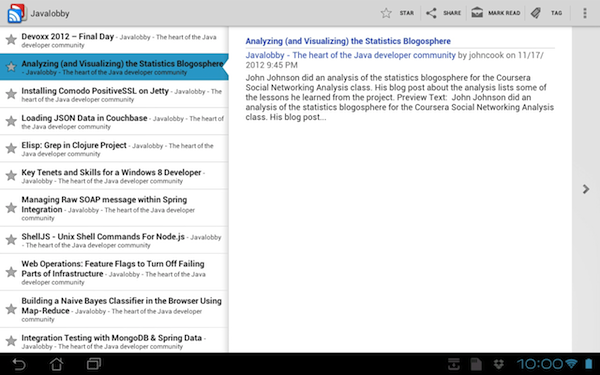
Reader on Transformer
The second screenshot shows how the larger size of the transformer triggers additional application navigation. It's a really important difference. I evaluate close to 50 articles from my feed each day to see if they're something I should read, and the expanded navigation lets me that process that information much faster. Reading the actual article from the feed often can work on the Nexus 7, but that's only a small part of the experience.
I really did want to like my Nexus 7. The little guy is snappy, responsive, and a pleasure to use. Regrettably, though, it can't handle the few uses I have for which a tablet is actually well suited.